

Finishing
As of 2025, four of the six houses, comprising the project in Jethabhai ni pol, have been completed
House no.1
Pratima ni Haveli is our ancestral home that has been in the family for over 300 years, with only 2 water closets housed along the street, detached from all the bedrooms.


Seven ensuites were added using existing corridor spaces, hidden rooms and balconies, so as not to redefine the geometry of the original bedrooms and have any effect on the existing facades.

The bedrooms on the 2nd floor did not have corridors and hidden rooms to exploit into water closets.
In these cases, a unit was designed based on the traditional wash areas; that were made with wood partitions and coloured glass.
The new ensuite units are made with lightweight materials, wood, glass and locally sourced reverse paintings.
The false ceiling of the bathroom houses the AC units.

House no.2
The ground floor of House 2 has a 2000 sf. apartment for long term stay or a residency.


The first floor has a design and tailoring studio, where guests can get custom tailoring done as well any administrative tasks. Two existing bedrooms on the second floor were refurbished and ensuites added.
House no.3
The entire building had to be demolished and rebuilt anew.


House 3 is located such that from there one can feed all the four houses with utilities and amenities such as a standard staircase and an elevator, making the entire scheme 90% handicap accessible.
At the ground floor it becomes part of the entrance lobby space from where one can access all the vertical circulation.
On the first floor it's a part of the dining space, and at the second floor it provides access to the roof level via the elevator and ramps.
Lastly above the roof level the bulkhead houses the overhead water tanks and a sound booth for future open air concerts.
House no.4
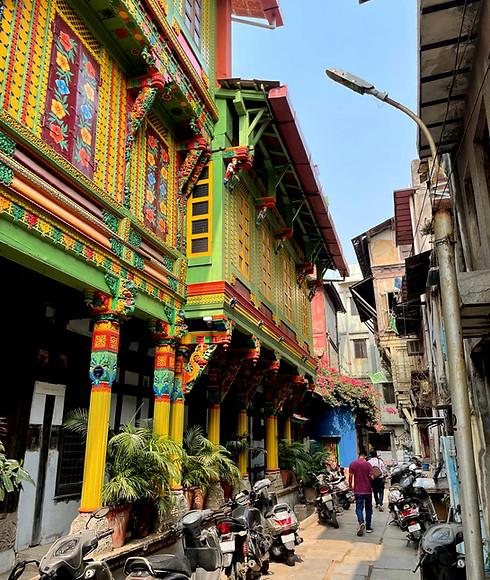
During the process of construction it was discovered that houses 3 & 4 had originally been one house. The facade of house 4 was restored and the facade of house 3 was built new to match.

On the ground floor is the main entrance and lobby, with an ancillary retail shopping space.


On the first floor is a fine dining restaurant with a professional kitchen.
The space is multipurpose and can seamlessly morph into a conference space with a small cafe.
The second floor has two large bedrooms with ensuites, 10 KV of solar panels are to be installed on the non-street facing roof of house 4.


A New Landscape
Every ancestor that has added to this structure over the past hundreds of years, has always included in their renovation works; the construction techniques, the fashion and architectural ambulations of their times.
It was eminent to our philosophy 'that conservation should be a propelling force' and that new a layer of elements from our times had to be added to the project.
This is primarily done by converting the pitched roofs that were setback from the street into flat roofs while still keeping each roof's original height, creating a multi level roofscape


All the different levels of the existing structures were maintained and converted into flat roofs with mosaic flooring or kept pitched and finished with shingles, in order to keep them usable for the big kite flying festival.
However there was an issue; the east and west terraces had two large courtyards between them, with only a 450mm thick wall connecting them.
A symetrical steel cantilevering system was designed that would stem from the existing 450mm wall to create a bridge terrace to seamlessly connect the two sides.


By creating a multilevel roofscape, each area is defined as it own independent space


The bulkhead with a sound booth looks over an open area to be used for yaga, concerts and sleeping under the stars

The garden part of the terrace has a victory column with a Nandi (Lord Shivas gatekeeper and mode of transport) looking towards the main Shiva temple that is 50m to the south.
The Nandi makes an axial connection with the temple, a primary structure and urban generator that influenced the street layout of the neighbourhood.


The next level down, is a multipurpose room with a library, exercise space, a kitchenette and a water closet.
The adjacent terrace has a small fountain to emulate the sound of water, a wood fired oven and a tandoor.

Detached now from the main terrace and public access, the next two levels down is a 6m high aviary with hanging gardens.
Birds in large cages had been a staple in the household and there was a utility courtyard existing with a hollow steel tube structure with rods for security purposes.
The steel structure instead of being flat was curved to form a two level bird garden.

By creating a 'new landscape' at the roof level and providing easy access to it, a new way has been composed to experience the past
